
E Major
 Show Hand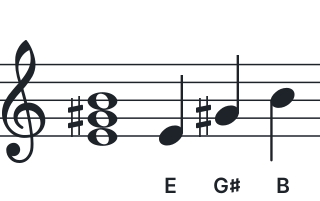
The E major chord is a triad formed from a root (E), a major third (G♯) and a perfect fifth (B).
How to play E major on the piano
To play the E major chord, start by finding the root of the chord: E. Look for the black keys in groups of two on the keyboard. The white key directly to the right of these black keys is E.E major is made up of the notes E, G♯ and B. Using your right hand, you'd play the chord in its root position with the following fingers:B - Fifth finger (5)
G♯ - Third finger (3)
E - First finger (1)Read: Our guide to major and minor chords.Use the following fingers to play the root position chord with your left hand:B - First finger (1)
G♯ - Third finger (3)
E - Fifth finger (5)Depending on the music you're playing, you might find it easier to use other fingers to play E major. To see how the chord is built, check out our video above.
G♯ - Third finger (3)
E - First finger (1)Read: Our guide to major and minor chords.Use the following fingers to play the root position chord with your left hand:B - First finger (1)
G♯ - Third finger (3)
E - Fifth finger (5)Depending on the music you're playing, you might find it easier to use other fingers to play E major. To see how the chord is built, check out our video above.
What are the inversions of E major?
Beyond its root position chord, E major has two additional inversions. You can learn how to play these inversions of E major below.How to play the first inversion of E major
In the first inversion of E major, place G♯ as the lowest note of the chord. With your right hand, you'd play this chord using the following fingers:E - Fifth finger (5)B - Second finger (2)
G♯ - First finger (1)Read: Our guide to chord inversions.
How to play the second inversion of E major
The second inversion of E major has B as its lowest note. Use the following fingers to play the chord with your right hand:G♯ - Fifth finger (5)E - Third finger (3)
B - First finger (1)


