
B♭ Major
 Show Hand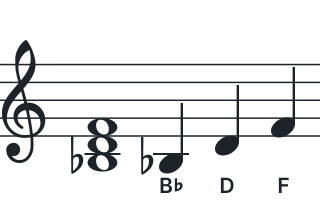
The B♭ major chord is a triad formed from a root (B♭), a major third (D) and a perfect fifth (F).
How to play B♭ major on the piano
To play the chord B♭ major, first you should find the root of the chord: B♭. On the piano, look at the black keys in groups of three on the keyboard. The farthest right black key in these groups is B♭.The B♭ major chord is made up of the following notes: B♭, D and F. To play the chord in its root position, use the following fingers with your right hand:F - Fifth finger (5)
D - Third finger (3)
B♭ - First finger (1)Read more: Our guide to major and minor chords.To play the chord with your left hand, use the following fingers:F - First finger (1)
D - Third finger (3)
B♭ - Fifth finger (5)For some songs and pieces, you might be better off using different fingers to play the notes of B♭ major. To see how the chord is built, watch our video above.
D - Third finger (3)
B♭ - First finger (1)Read more: Our guide to major and minor chords.To play the chord with your left hand, use the following fingers:F - First finger (1)
D - Third finger (3)
B♭ - Fifth finger (5)For some songs and pieces, you might be better off using different fingers to play the notes of B♭ major. To see how the chord is built, watch our video above.
What are the inversions of B♭ major?
The inversions of B♭ major use the same notes as the root position chord but rearrange the order. Learn how to play the first and second inversions below.How to play the first inversion of B♭ major
You can play B♭ major's first inversion by placing D as the lowest note. With your right hand, use the following fingers:B♭ - Fifth finger (5)F - Second finger (2)
D - First finger (1)Read more: Our guide to chord inversions.
How to play the second inversion of B♭ major
B♭ major's second inversion can be played by placing F as its lowest note. To play it with your right hand, use the following fingers:D - Fifth finger (5)B♭ - Third finger (3)
F - First finger (1)


